How Restaurants Keep Food Fresh
We set the stage by defining how we balance diner expectations with daily operations. Our focus is simple: maintain quality while meeting safety and cost goals.
Surveys show about 70% of diners will pay more for ingredients that taste and look better. That expectation drives our storage and food storage routines, from temperature checks to airtight packaging.
We rely on clear practices to control temperature, humidity, air exposure, and separation of raw and ready-to-eat items. These steps reduce waste and support food safety across every shift.
Standard labeling, dated containers, and FIFO make tasks repeatable for every team member. This management approach improves efficiency, lowers losses, and keeps customers returning for consistent freshness.
Why Freshness Matters in Our Kitchens Right Now
Delivering peak flavor and safety requires we treat freshness as an operational standard, not an afterthought. That focus drives decisions from ordering to prep, and it helps us protect quality and reduce loss.
Customer expectations and quality payoffs
When customers value freshness, we elevate food safety and storage routines. Guests who find consistent quality return more often and recommend our place to others.
Operational efficiency, cost control, and compliance
Clean, tuned refrigeration and disciplined storage extend shelf life and lower waste. Clear labeling, dating, and simple management rules speed service and cut costly errors.
- Minimally processed ingredients support health and reduce packaging impact.
- Better storage helps us buy right, rotate stock, and avoid spoilage.
- Routine checks and logs make audits smoother and protect our reputation.
| Benefit | Impact | Practical step |
|---|---|---|
| Longer shelf life | Lower waste, higher yield | Maintain clean refrigeration and monitor temps |
| Consistent quality | Repeat customers | Standard labeling and FIFO |
| Better compliance | Fewer violations | Documented checks and staff training |
How Restaurants Keep Food Fresh
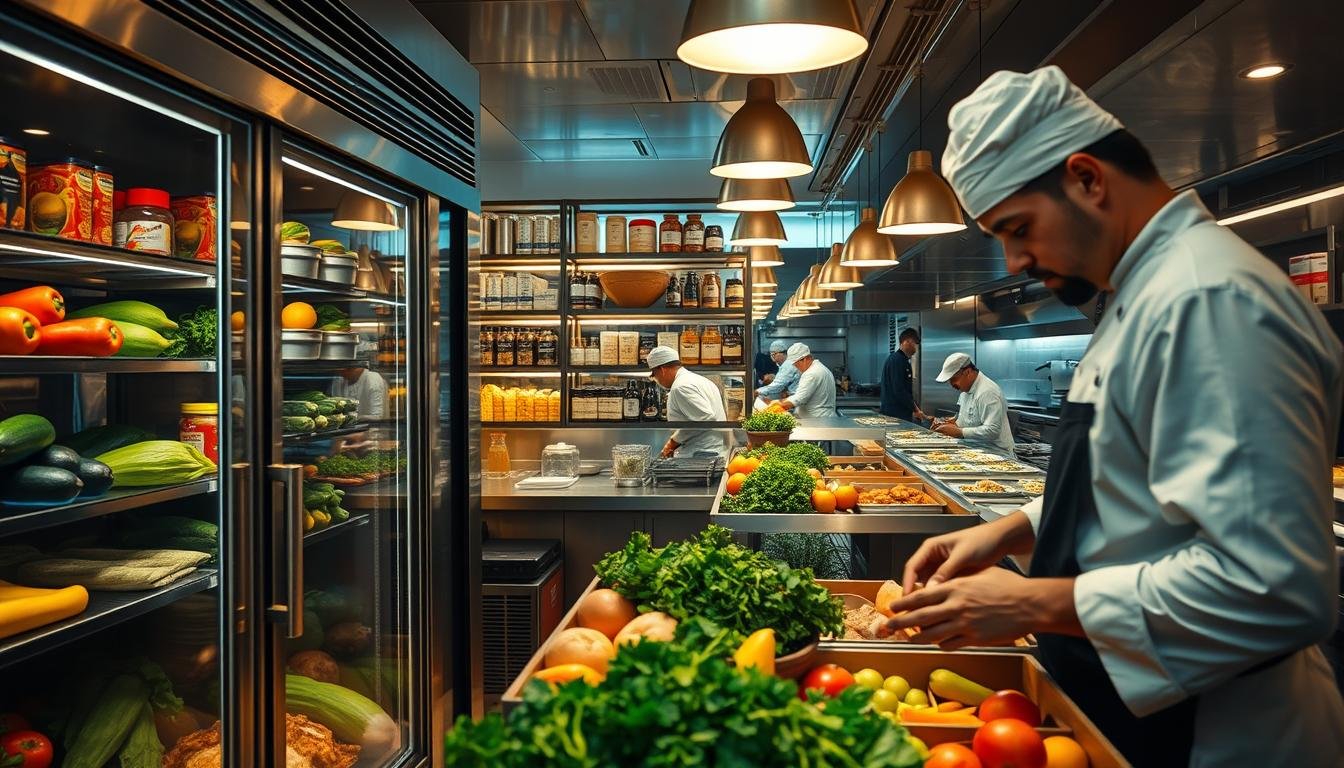
Clear storage zones cut confusion and make safe handling routine for every shift. We map cold, frozen, and dry areas so teams know where to place products. This management reduces errors and supports safety checks.
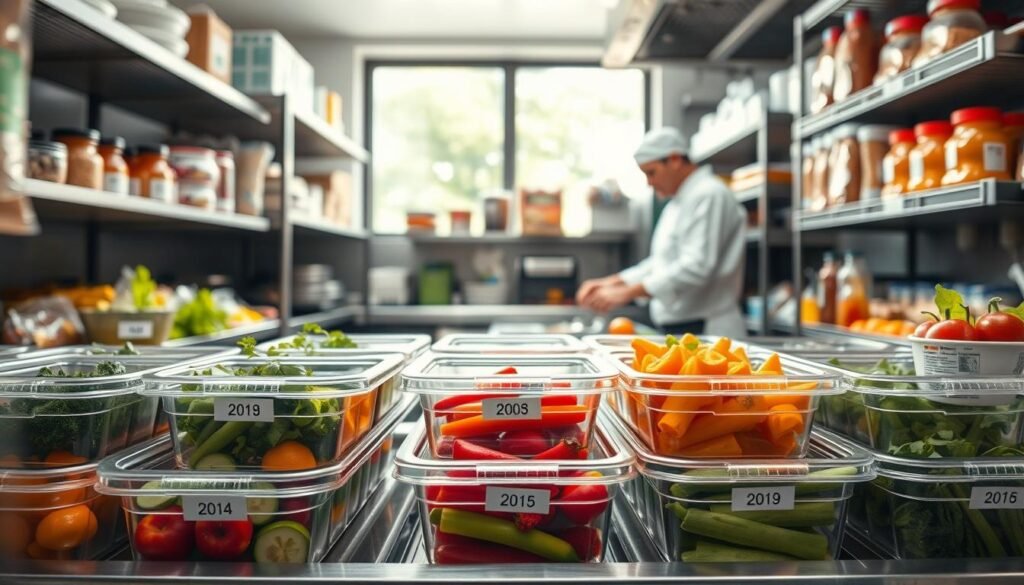
We use airtight containers and vacuum sealing to limit air exposure. These containers protect ingredients, slow oxidation, and help us store food longer. Staff stage popular items up front to speed service and reduce handling.
Raw proteins live on low shelves in dedicated pans to prevent drips onto ready-to-eat items. Every container is labeled with contents and dates so FIFO is straightforward. That practice keeps items moving and avoids hidden stock.
Daily logs track refrigerator temps, dates, and corrective actions. Short training refreshers keep our staff aligned on hygiene and handling practices. Together, these steps make our restaurant storage reliable and consistent.
| Area | Primary control | Practical tip |
|---|---|---|
| Cold zone | Temperature & labeling | Use thermometers and date containers |
| Frozen zone | Air-tight sealing | Vacuum bags for long-term storage |
| Dry zone | Ventilation & off-floor storage | Dedicated shelving with clear labels |
| Monitoring | Logs & corrective actions | Assign daily checks to one staff member |
Mastering Temperatures, Humidity, and Airflow for Food Safety
We rely on precise environmental settings to protect ingredients and prevent loss during service. Clear rules for temps, humidity, and layout reduce risk and make safety measurable.
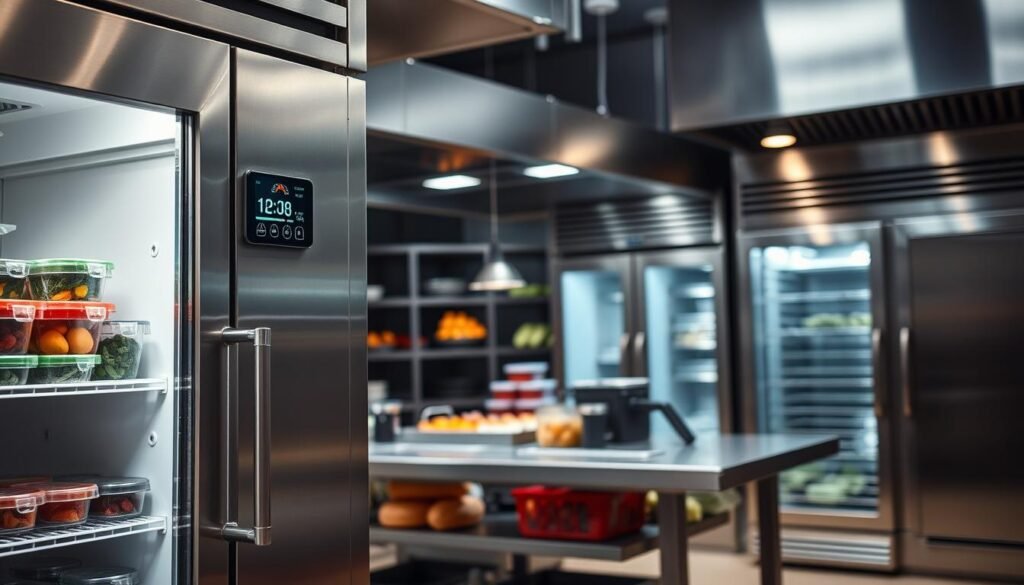
Cold holding matters: refrigerators must stay at or below 40°F and freezers at or below 0°F. We verify readings with calibrated thermometers placed in multiple zones to detect variance.
Hot items are held above 140°F to prevent bacterial growth and to preserve the results of careful cooking. Staff log temperatures at open and close and record corrective actions when units drift.
- Use humidity control and ventilation in dry storage to lower mold and spoilage risk.
- Place raw proteins on low shelves and ready-to-eat items above to prevent cross-contamination.
- Audit airflow around condenser coils and avoid overpacking so cold air circulates evenly.
| Control | Target | Practical step |
|---|---|---|
| Refrigeration | ≤ 40°F | Independent thermometers in multiple zones |
| Freezing / Hot holding | ≤ 0°F / ≥ 140°F | Daily logs and immediate corrective actions |
| Airflow & Humidity | Balanced ventilation, low RH in dry storage | Inspect coils, use dehumidifiers where needed |
We train teams on the danger zone and pair readings with visual checks for frost, condensation, or pooling water. Those practices keep our storage conditions consistent and protect safety for guests.
Advanced Preservation Methods That Extend Shelf Life
We use advanced preservation to extend shelf life while matching menu needs and service pace.
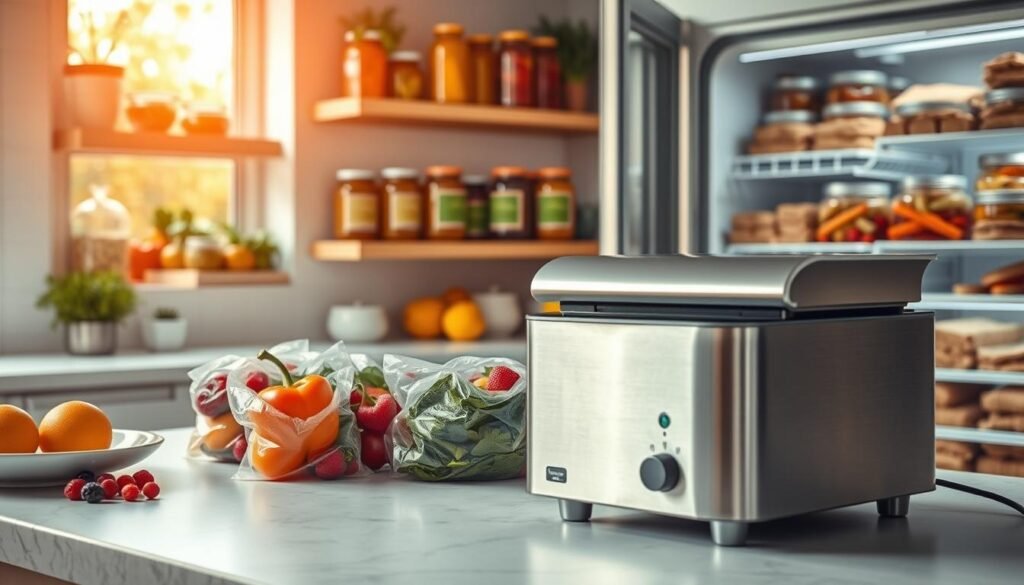
We deploy vacuum sealing to cut oxygen and protect aroma. Non-cooked vacuum items are held at or below 41°F for up to 14 days. For proteins like fish, we freeze immediately after packaging.
Sous vide lets us cook precisely and store safely. Typical timelines are 48 hours at 41°F, 72 hours at 38°F, and 30 days at 34°F. If frozen, items may be held longer per local guidelines.
We also use dehydration, freeze drying, pickling, canning, fermentation, and flash freezing to control moisture and texture. Controlled-atmosphere storage helps slow ripening for high-value produce.
- We chill sealed bags fast, document containers, and log temperatures.
- We match technology to menu volume, for example using the Breville Commercial MX2 Infuser for sealing and marination tasks.
| Method | Primary benefit | Practical limit |
|---|---|---|
| Vacuum sealing | Less oxygen, longer aroma | ≤41°F, 14 days (non-cooked) |
| Sous vide | Even tender results | 48h@41°F; 72h@38°F; 30d@34°F |
| Flash/cryogenic | Texture preservation | Immediate freezing after packaging |
Produce Preservation: From Ethylene Control to FIFO
Produce needs matching storage to perform at its best from prep to plate. We group items by temperature and humidity so each vegetable and fruit sits in the conditions that protect texture and flavor.
Match produce to ideal temperature and humidity ranges
Apples and carrots prefer colder, higher humidity. Bananas require warmer, lower humidity. We set refrigerator zones and liners to hold those bands and prevent wilting or chill damage.
Separate ethylene producers from sensitive items
We stage ethylene producers such as apples, pears, and bananas away from sensitive items. That prevents premature ripening and saves shelf life for delicate vegetables and prepared items.
Run regular audits to align ordering with shelf life
Labels with dates and clear FIFO placement make rotation simple. We run weekly inventory audits to compare expected expiration windows with real outcomes.
- Use slotted racks and shallow pans for airflow and gentle handling.
- Post storage guidelines near the walk-in with temperature set points and zone maps.
- Calibrate thermometers and log temperatures to confirm stable conditions.
| Group | Target conditions | Action |
|---|---|---|
| Cold, high humidity | 32–40°F; high RH | Apples, carrots; liners and vents |
| Warm, low humidity | 55–60°F; low RH | Bananas; separate shelf, avoid cold |
| Delicate greens | 34–38°F; moderate RH | Shallow pans, breathable covers |
Bringing It All Together for Consistent Freshness and Less Waste
We close by showing how simple systems turn routine checks into consistent quality. The basics are clear set points, labeled rotation, and daily logs that document temperature and corrective actions.
We maintain refrigerators at or below 40°F and freezers at or below 0°F, and hold hot items above 140°F to block bacterial growth. FIFO labeling, airtight containers, and vacuum sealing reduce spoilage and extend shelf life.
Staff training, hygiene, and clean zones stop cross-contamination and make safety repeatable across every kitchen. We measure outcomes—waste rates, out-of-range temps, and guest feedback—to refine storage guidelines and preservation choices.
Scaled SOPs, unified labeling, and scheduled maintenance tie the process together so our restaurant teams can store foods correctly, protect quality, and reduce waste over time.